Thank you! Your submission has been received!
Oops! Something went wrong while submitting the form.

Result Example
Result Example
Result Example
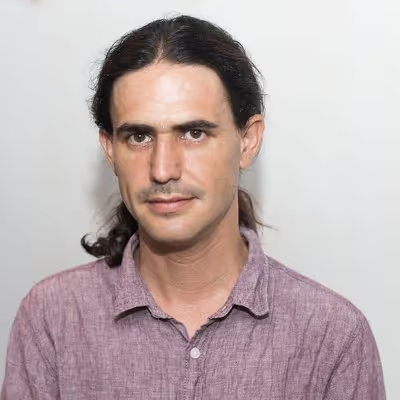
Abdel Rahim Haj Yahya, an Israeli citizen, was convicted of incitement to terror soon after October 7. He is convinced it was because of his large following.
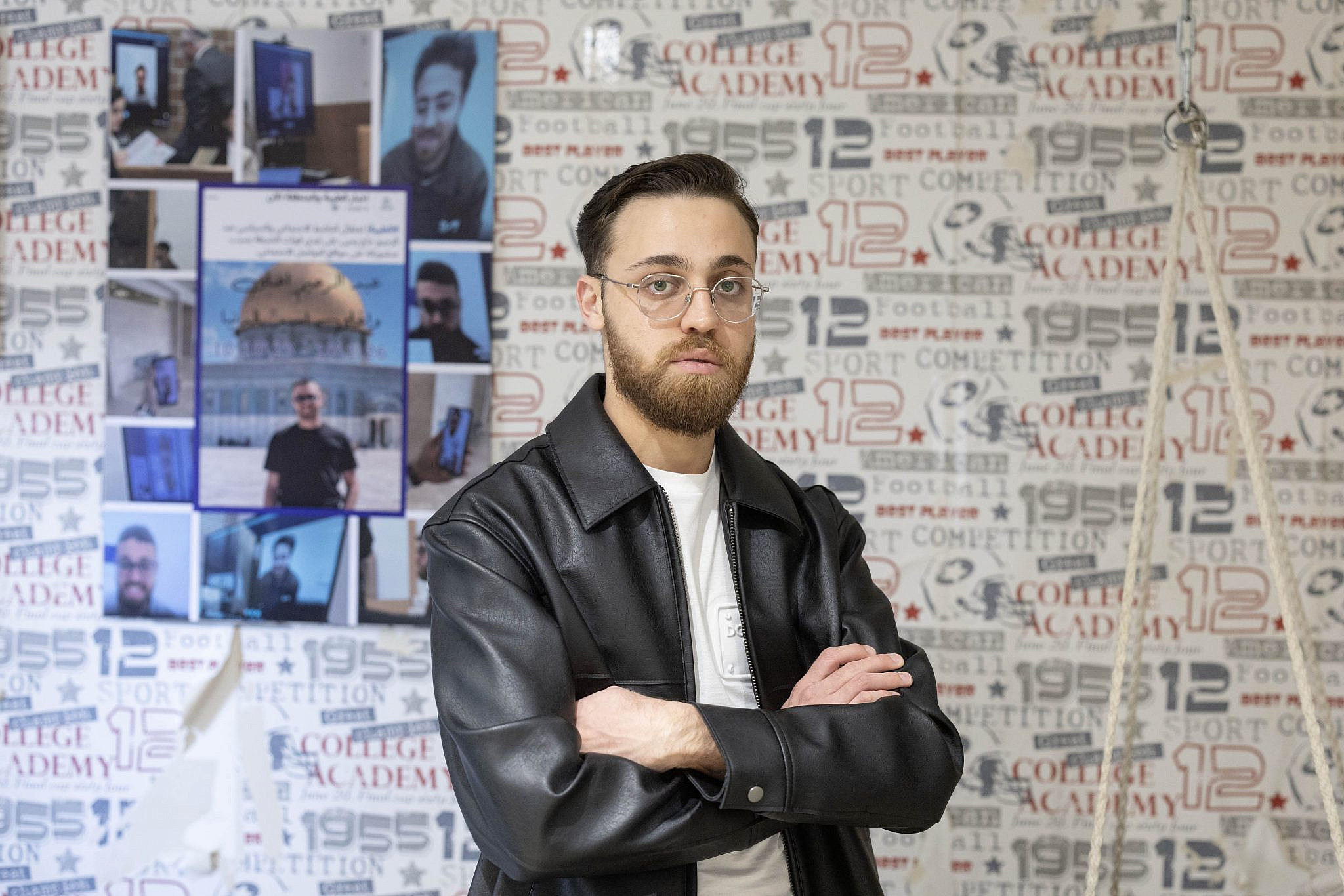
On Instagram these days, Abdel Rahim Haj Yahya is back to documenting his daily activities for his 117,000 followers. It is hard to believe he was released from prison only a few weeks ago, after serving more than two years for social media posts uploaded around the time of the October 7 attacks — one of the harshest punishments imposed on an Israeli citizen for offenses of this kind.
Haj Yahya, a 23-year-old social media influencer from the Palestinian city of Tayibe in central Israel, was arrested on Oct. 10, 2023. In an instant, one of the most prominent online voices among Palestinian citizens of Israel — posting about political developments in the West Bank and Gaza, and distributing gifts to Palestinian children in hospitals and refugee camps — disappeared.
There was a dense fog surrounding his case: Neither mainstream Israeli nor Palestinian news channels covered the affair, and repeated attempts by a few journalists and activists to find out what had happened to him confronted a wall of silence.
“None of what he went through, including the conviction and the sentence, would have occurred if he were not someone well-known — and would not have happened in the same way before October 7,” explained Shua’a Mansour, Haj Yahya’s attorney and the former mayor of Tayibe. “At the heart of this affair stands one fundamental question: What is freedom of expression?”
The 27 months that Haj Yahya served in Israeli security prisons left a deep mark on him. He lost about half his body weight, but equally conspicuous was the shift in the content of his social media posts. Since his release, he has not posted about human rights abuses or aid activities for Palestinian children in hospitals and camps; indeed, he now avoids political references altogether. He has learned what is permissible to discuss inside Israel, and what is better left unsaid.
Haj Yahya spoke to +972 Magazine about his arrest, interrogation, and imprisonment, and how the terms of his release are meant to send a clear message about the limits of Palestinian speech.
What happened on the day of your arrest?
On Oct. 10, several masked police officers arrived at my home and arrested me. It was not a large force: In hindsight, I understood that they wanted to carry out the arrest quietly, because I am a known figure.
I found myself in 10 days of interrogations on suspicion of incitement to terror. It mainly concerned 10 posts, seven of which were uploaded before October 7 and three afterward. Some included images from the events that took place in the ‘Gaza Envelope’ with mention of the date, nothing beyond that.
One of the posts contained a video that I received from Israeli Telegram channels, meaning material that was not prohibited from publication. In one of the posts I wrote that these were “historic images” — not as a celebration [of October 7, but noting] that this was an important event that would be part of history. Despite this, the posts were interpreted as incitement and as an expression of support for terror.
Later, the investigators found a picture of me on social media during a visit to distribute gifts to children in the Jenin refugee camp, in which I am holding a rifle. This was a random, momentary picture, but it led to an additional indictment: aiding and abetting the possession of a weapon.
After a long process of interrogations and court hearings, I was convicted and sentenced to 27 months in prison. I served them in full, without reduction, leniencies, or mitigating conditions.
Did you ever imagine that you would end up in prison for such a long time because of social media posts?
I had heard about people being arrested for expressing their opinion online, and given that I am active on social media I was not surprised about the arrest itself, especially in light of the atmosphere that prevailed in the country at the time.
Three months before my arrest, in the summer of 2023, I received a phone call from the police in which they verified my ID number and summoned me for questioning. The next day they called again and claimed that there had been a case of mistaken identity. In hindsight, it seems that they couldn’t find sufficient material for an indictment and therefore postponed the investigation to look for additional grounds for arrest.
But [when I was arrested in October] I did not believe that I would receive such a heavy punishment. The harshest punishment I could remember for expressing political views was the one imposed on Sheikh Raed Salah [the leader of the northern branch of the Islamic Movement in Israel, who was sentenced in 2020 to 28 months in prison for incitement], and I never imagined that I would receive a punishment like his.
I believe the fact that I am a well-known figure, with tens of thousands of followers, led to this severity. Throughout the hearings it was said again and again [by the prosecutors] that I am a blogger and a social media influencer. In one of my interrogations, an investigator told me that someone who carries out an attack is less dangerous than me because he acted alone, whereas my influence reaches many.
Can you describe the conditions of your interrogation and imprisonment?
I was not beaten during the interrogations, but there were shouts, threats, and a harsh atmosphere. As for the imprisonment itself, I spent the first 10 days in Megiddo Prison and the rest in Gilboa Prison, where I met veteran and well-known prisoners, new prisoners arrested after October 7, prisoners of conscience, as well as a Syrian prisoner and a prisoner from Turkey, who, according to what I was told, was arrested after trying to enter Israel through the Golan Heights.
Everyone knows how the conditions inside Israeli prisons worsened dramatically after October 7, and even the most basic leniencies were taken away. I prefer not to go into too many details, because I do not want my words to be misinterpreted again. I will say only this: Everything that has been said about what is happening in prison, I saw with my own eyes.
Why did your case receive such little media attention, and why did your family choose to stay silent?
Shua’a Mansour, my attorney, deliberately preferred not to bring the story to the media and for it to go public. We feared that this would lead to incitement against me and negatively affect the legal process.
The prosecutors tried to turn my case into a “public-figure affair,” emphasizing that I am an influencer and a known figure on social media. But if it had exploded in the media and been accompanied by incitement, it is very likely that the punishment would have been even harsher.
You are the eldest son in the family, and your siblings are still children. How did the family cope with the arrest and the trauma?
My family paid the heaviest price. The shock and anxiety did not leave them for a second, even since my release.
My brother was only 8 years old when I was arrested; he developed severe trauma and could not return to school for an entire year. Another brother experienced a mental shock that led, shortly afterward, to a traffic accident. My father, even though he is a relatively young man, now takes no fewer than 12 medications a day.
Throughout the entire period of my arrest, not a single Knesset member, leader from the High Follow-Up Committee, or any other official body contacted us — not even to ask about the family’s well-being or to establish contact with me. They definitely knew about the case. The feeling of abandonment was difficult, almost unimaginable.
I had previously heard about similar failures toward detainees from the events of May 2021, but I did not believe that the reality was so severe. There is no justification for abandoning a helpless family after their son was arrested and imprisoned for expressing an opinion — not the shock of October 7, nor fear of criticism or incitement.
Were any conditions imposed on you after your release?
There is the standard condition of re-arrest in the event of a similar offense in the future, namely incitement to terrorism. Beyond that, even before my release, the prison guards warned me that I should refrain from speaking and providing details about my prison experience, that such things could cause me more legal problems.
It is clear to me that this warning was intended to create a chilling effect. I know that any statement can be interpreted, at any moment, as incitement. The prosecutors had connected my social media posts [around October 7] with earlier statements and posts, determining that they constitute incitement and support for terror even though they contain no such thing.
My lawyer submitted a petition to the High Court against this interpretation, and one day after I was released the court agreed to reconsider it. We will continue to conduct the proceedings with the aim of reaching an acquittal, because the posts for which I was convicted do not include, in our view, any incitement.
A version of this article was first published in Hebrew on Local Call.